
Does Artificial Intelligence Kill Creativity or Help Us Think More Broadly?

Ilze Boitmane
Published: 20.05.2026.
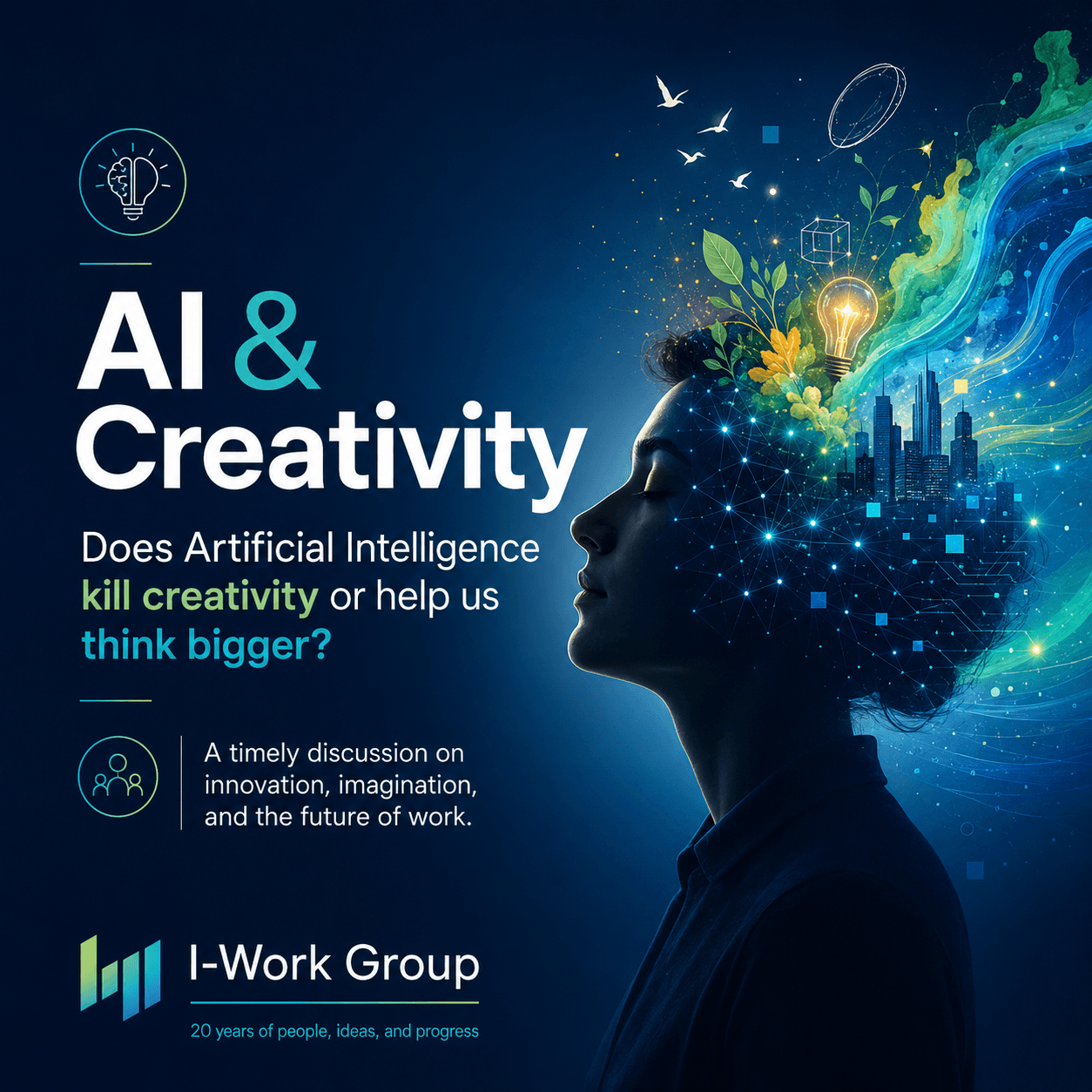
As I-Work Group approaches its 20th anniversary, which we will celebrate in the autumn season, one of the key themes for us remains creativity and innovation within the company and the team. This time, the discussion focuses on artificial intelligence and creativity.
In recent years, artificial intelligence has evolved from a technological novelty into an everyday work tool. It helps create extensive texts and content, analyse data, generate new ideas and images, prepare presentations, and find solutions much faster than before, saving a significant amount of time.
However, along with this convenience comes an important question: what happens to human creativity and thinking if the first idea, the first sentence, or even the first direction for a solution is offered by artificial intelligence? Does it suppress a person’s willingness to think independently?
Does AI help us become more creative? Or does it make our thinking more uniform — faster, but also more superficial? AI can be a powerful assistant if we know how to work with it, but it can also become a threat if it makes us passive, inactive, and even dependent on AI.
Creativity Is Not Just a “Good Idea”
We often perceive creativity as the ability to come up with or invent something new and unprecedented. It is often associated with something “tangible”, visually or audibly enjoyable. However, in reality, creativity is much broader. It is a process in which a person connects experience, knowledge, intuition, emotions, and understanding of a specific situation, forming their own perspective. This can happen in almost any profession, even in those where we might think that “nothing new can be invented”.
Creativity is not only the rapid generation of new ideas. It is also a question of why a particular idea is valuable, whom it helps, what problem it solves, and what meaning it brings to people, a team, or an organisation.
This is where a key difference between humans and technology becomes visible. Artificial intelligence can offer many options, but a person is able to evaluate which of them is the right one. AI can create content, but a person gives it context, emotional nuance, and purpose. Or, conversely, if we ourselves have no idea or thought at all, then AI will not be able to help us fully either.
AI as an Accelerator of Creativity
The positive side is obvious. Artificial intelligence is highly effective in helping to overcome the so-called “blank page” feeling. Many people are familiar with situations where, for example, a text needs to be written, a campaign idea needs to be developed, a presentation needs to be structured, or a new focus needs to be found, but the beginning does not come easily. There may be a sense of procrastination or a “blackout”. Everyone deals with it differently.
In such moments, AI can become a useful thinking partner and a stimulus for thinking more broadly, helping us look for new contexts. It can offer several options, help organise chaotic thoughts, provide the first structure, or show the topic from another perspective.
This does not mean that AI does the work instead of the person. Rather, it helps to reach the first draft more quickly, which the person then transforms, complements, evaluates, and adapts. Similar to a conversation with a colleague, sometimes one question or comment is enough for the thought to start moving forward.
In a professional environment, this can be especially valuable. Teams can generate ideas faster, test different communication directions, prepare several scenarios, or reach a solution prototype more quickly. This can support innovation because it reduces the time between the idea and its testing.
Where Do the Risks and Problems Begin?
The problem begins when AI shifts from being an assistant to becoming the main thinker. If a person increasingly starts work not with their own idea, but with a proposal from artificial intelligence, the thinking process itself may gradually begin to change. Those who have already worked with AI for some time will understand that AI’s way of thinking can often be quite uniform. In addition, it can be inaccurate, overly illusory, or something it has already offered to others.
Creativity develops when we search, make mistakes, doubt, reformulate, and try again. It is precisely this uncomfortable and sometimes slow process that often leads to the most original solutions. If we completely replace this stage with a ready-made answer, there is a risk of becoming editors rather than creators of ideas.
AI tends to offer logical, correct, and safe solutions. They often sound quite good, but they are not always truly original. If everyone uses similar tools, similar prompts, and similar approaches, content and ideas can become increasingly uniform. As a result, we get many correct solutions, but only a few truly distinctive ones. A large amount of similar material is created, without high added value.
One of the biggest challenges is not that AI will “kill” creativity, but that it may make creativity convenient, predictable, and too similar to others — or even almost identical. Of course, if a person does not think at all, this may also seem like one of the solutions, but the real question is how valuable it will be in the long term.
Human Experience Cannot Be Automated or “Rewritten”
No matter how advanced technology tools become, human experience still has a special role. In creative ideas, the most important aspect is often not only the form, but whether the idea resonates with people. After all, the consumers of your ideas will still be people, not technologies.
Artificial intelligence can analyse a large amount of information, but it does not experience the work environment, team dynamics, client emotions, or the mood of society in the same way a person does. It can recognise language patterns, but it does not understand lived experience in a human way. Often, even language models can feel peculiar and distant from people’s natural, living language.
For example, in human resources, marketing, or communication, it is important not only to find the right words, but also to understand how people will perceive them. Will the message inspire? Will it sound genuine? Does it reflect the company’s culture? Will it preserve its human touch?
These nuances still require human judgement and decision-making. And it is precisely at this level that creativity becomes much more than simply generating texts or images.
Innovation Arises from the Interaction Between Technology and Humans
When speaking about innovation, AI undoubtedly opens up new opportunities. It helps analyse trends more quickly, model scenarios, identify connections, and test ideas. For companies, this can mean faster decision-making, more efficient processes, and the development of new products or services.
However, innovation is not only the use of technology. Innovation arises when technology solves a real human or business need. Therefore, it is important not simply to use AI, but to understand what problem we want to solve with its help.
This is where a person’s ability to ask high-quality questions becomes essential. The better the question, the more valuable the answer. The clearer the goal, the more meaningful the result. In the AI era, value shifts from the ability to “complete a task” to the ability to define a direction, evaluate the result, and make a wise decision. This requires relatively professional AI knowledge and skills. It is not enough to simply write a prompt in a chat: “come up with”, “tell me”, “give me”.
Does AI Threaten Creativity?
AI itself does not threaten creativity. What threatens it is careless, uncritical, and overly convenient use of technology. A person becomes inert, passive, and comfortable. Unfortunately, in such a state, new ideas rarely emerge. To arrive at a new idea, there must be “creative tension” — an insight.
If we use artificial intelligence as a substitute for thinking, it can weaken our ability to create original ideas. However, if we use it as support, it can expand our possibilities, accelerate the process, and help us reach solutions that we might otherwise never have considered. The question is not whether AI is good or bad. The question is how consciously we use it.
In Conclusion
Artificial intelligence is changing the way we work, think, and create. It can help us become more efficient, more courageous in the search for ideas, and more open to new opportunities. At the same time, it reminds us how important human skills remain: critical thinking, empathy, intuition, experience, and the ability to give meaning to ideas.
AI can generate options, but a person chooses the main direction. AI can accelerate the process, but a person defines the goal and the idea. AI can help create more, but a person evaluates what is truly valuable. AI can offer technical possibilities, but a person determines how they will be applied.
A Practical Insight: Recruitment in the Context of AI
Recruitment as a whole may seem like a field that is not particularly creative — rather, it may appear technical and analytical. However, even here, it is often necessary to design the implementation scenario for a recruitment project, understand resource mapping, and, most importantly, find the right person for the company, while being able to evaluate and motivate them.
Talent is not always visible in a well-written CV or a successful interview. Often, it requires specifically human professionalism, experience, and the ability to notice seemingly invisible things: qualities, values, compatibility with the company culture, as well as the right moment to make an offer.
Most importantly, it requires human communication and cooperation. This is where we see that recruitment includes many moments that are not standard, planned, or fully predictable. Much depends on human action, the ability to create a new strategy, and the ability to find the most suitable approach.
Recommended



Get the latest news, case studies & articles on recruitment, HR, and psychology