

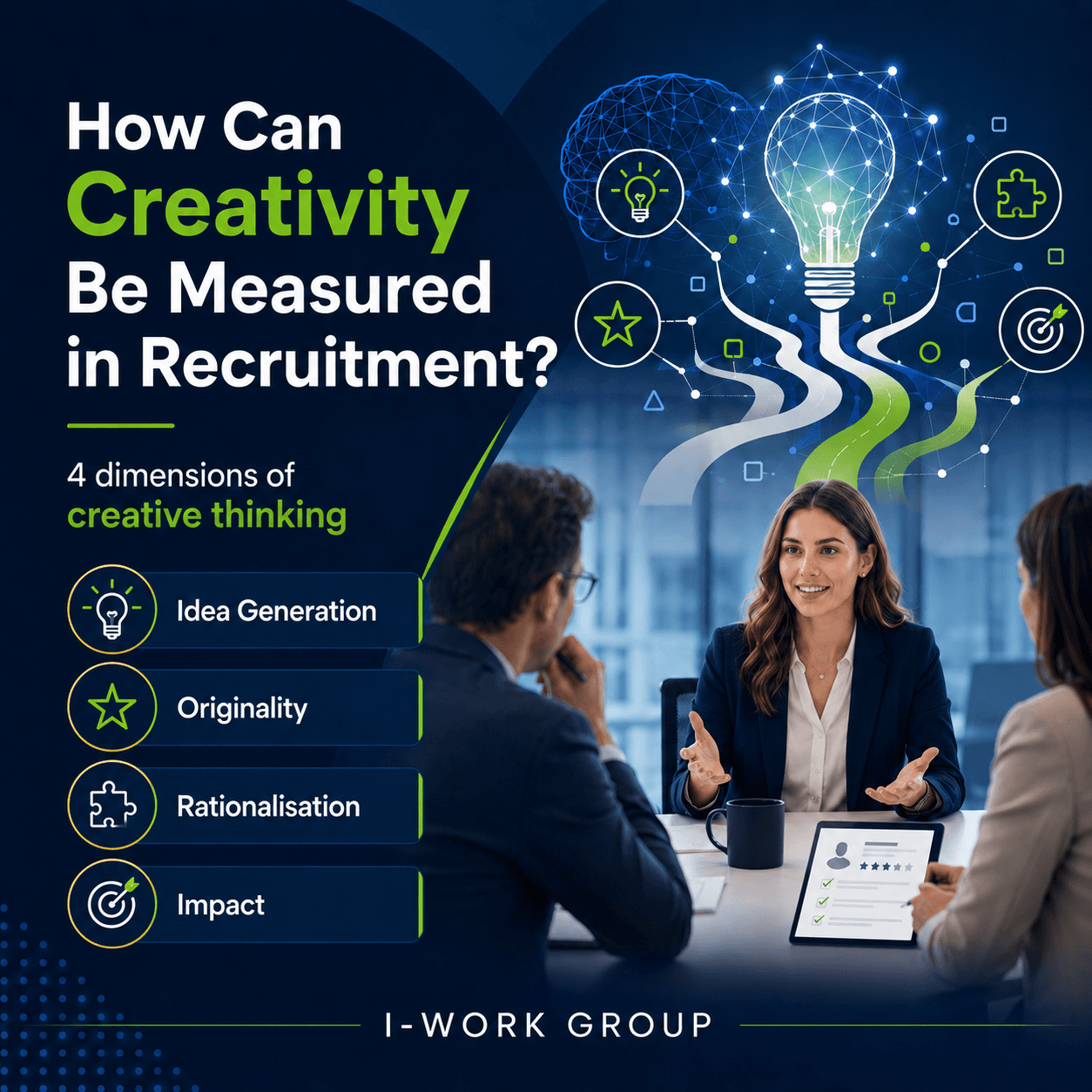
Continuing our article series on creativity in teams, the DNA of a creative employee, the assessment of creative and innovative personalities, and other topics chosen to mark I-Work Group’s 20th anniversary, this time we turn to the question of how, in recruitment and job interviews, we can evaluate whether a candidate possesses creative thinking.
The Rule of Four Dimensions
When thinking about creativity assessment methods, such as tests, tasks and interview questions, we can easily get lost in this “forest of methods” and conclude that assessing creativity is simply too complicated and time-consuming.
To make the process easier to understand, we can define four key dimensions and build the recruitment process around them:
range of ideas, originality of the idea, rationalisation of the idea, impact and sustainability of the idea.
Idea Generation: Can the Candidate See More Than One Path?
The first expression of creativity is a candidate’s ability not to stop at the first, most familiar, most traditional or most typical answer.
During a job interview, we can observe whether the candidate is able to find and propose several solutions to one problem. Are these solutions typical, or do they also reveal a less conventional approach? How does the candidate react when circumstances suddenly change and a new path has to be found?
Divergent thinking can be assessed by including not only standard interview questions, but also situational tasks in which the candidate is required to provide a specific solution.
It is important to evaluate not only how many ideas the candidate can name, but also whether these ideas are genuinely different and whether the candidate is able to continue thinking when the first solution proves unsuitable.
Originality: Can the Candidate Think Outside the Usual Framework?
The second criterion is not only the number of solutions, but also their originality: the ability to propose a new approach that does not simply repeat the familiar, or to notice a solution that others might not suggest.
However, caution is needed here. Creativity is not merely a storm of unusual or “crazy” ideas. In the workplace, what matters is whether the proposed ideas are connected to the real situation and whether they can actually be implemented in practice.
Therefore, at this stage of the recruitment process, there must be a close connection to the role for which the candidate is being considered. It is important to assess how the new approach could be applied in carrying out specific responsibilities or functions.
A candidate’s submitted portfolio can often be helpful here, as it may partly demonstrate their ability to think creatively and originally within a specific professional context.
Rationalising a Creative Idea: Can an Idea Be Turned into a Usable Solution?
Original ideas and possible scenarios for implementing them are not enough. Equally important is the candidate’s ability to rationalise an idea, in other words, to transform it into a usable solution, product, service or process improvement.
During a job interview, this can be assessed by asking the candidate not only to propose an idea, but also to outline a specific action plan. How would this approach be implemented in practice? What would the first steps be? What resources would be required? What risks might arise?
It is even more valuable to ask an additional question: What would the candidate do if the initial idea could not be implemented, or if new limitations suddenly appeared, such as a smaller budget, a shorter deadline, resistance from management or insufficient human resources?
At this stage of the recruitment process, both appropriately structured interview questions and a case study, or practical situation analysis, can be particularly useful. This is where it becomes possible to see whether the candidate merely generates interesting ideas or is also capable of connecting them with the realities of the workplace.
Change: Does the New Idea Create Real Impact?
The next step after implementing an idea, or creating a workable solution, is obtaining feedback. Does the created solution, product or service actually work? Does its existence change anything in the company’s processes, customer experience, consumer behaviour or the wider environment?
This aspect will be the most difficult to measure in a job interview, because the impact of a new idea cannot always be assessed over a short period of time. It is also important to consider whether the company where the candidate previously worked actually measured feedback and analysed how the new solution affected results.
Today, a product or solution is often developed through a relatively fast MVP stage and then launched on the market or introduced into operations. However, its long-term impact is not always assessed.
Therefore, in this dimension, the candidate’s account may be partly subjective. Nevertheless, during a job interview, it is valuable to ask how the ideas, products or solutions they created have changed processes, company operations, customer experience or people’s habits.
Not every idea has to change the world. However, one sign of valuable creativity is the candidate’s ability to understand what their idea has changed and why that change matters. It is also important to remember that change does not necessarily have to be positive.
In Conclusion
This time, we have explored four essential aspects that can be integrated into the job interview process in order to assess a candidate’s creative thinking:
range of ideas, originality of the idea, rationalisation of the idea, impact and sustainability of the idea.
Creativity is not only the ability to come up with something new. In the workplace, what matters is whether a person can see several possible paths, propose an original approach, turn an idea into an implementable solution and understand what kind of impact that solution creates.
Recommended


Get the latest news, case studies & articles on recruitment, HR, and psychology